SnagBane
Because SnagBane runs on your own server, your organisation is the controller of the data in it — the vendor never receives it. That keeps personal data inside your infrastructure and out of third-party clouds. On top of that, SnagBane helps with data minimisation (a retention policy on the Enterprise plan) and with data subject requests (on every plan).
Self-hosting and GDPR
- Forms, answers and uploads are stored in your database on your server, in the country you choose.
- Nothing is sent to other services unless you set up an integration or email.
- Consent questions store the exact text and the server time with each response.
Data retention (Enterprise plan)
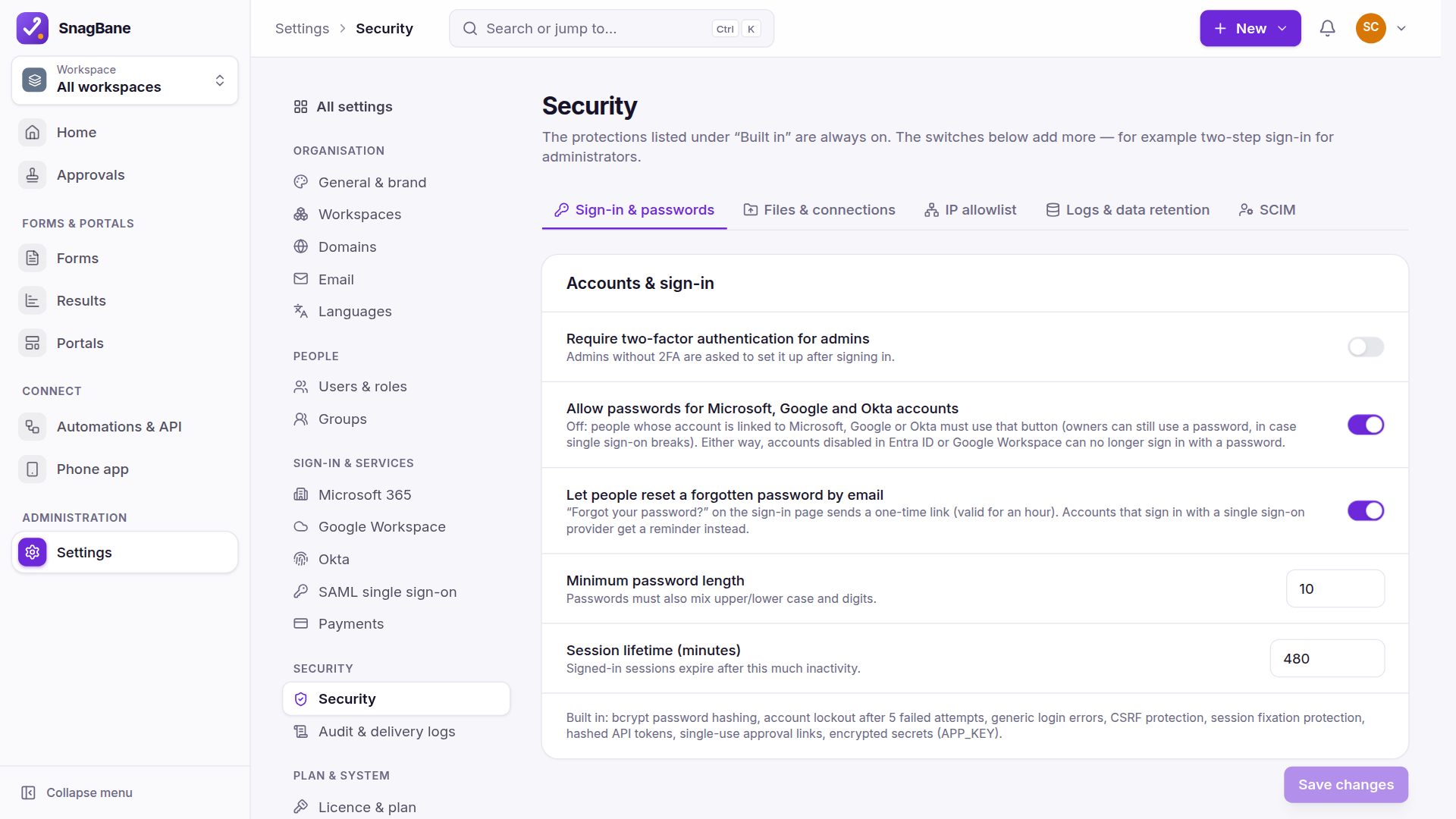
Under Settings → Security → Data retention:
| Setting | What it does |
|---|---|
| Delete old responses automatically | Off by default |
| Keep responses for | 30 days to 10 years, or any number of days, counted from submission |
| Per form | Follow the policy, keep its responses, or its own number of days |
| Lock it | Stop form editors from choosing another period |
Every night SnagBane deletes responses older than that — answers, uploaded files, signatures and approval history. Requests still waiting for approval are never deleted. The card shows what is due for deletion per form, and every run is written to the audit log. php artisan snagbane:retention --dry-run shows what would be deleted.
Data subject requests (every plan)
- Find a person's responses in Results by name or email; open or delete each.
- Export responses as CSV or Excel.
- The audit log records exports and deletions.
- Templates Data subject request (GDPR) and Data breach report are among the 118 templates.
Frequently asked questions
Is SnagBane a data processor for our form data?
No. You run it yourself, so SnagBane never has access to that data. Our data processing addendum only covers data you send us for support.
Can we decide how long data is kept per form?
Yes, with the Enterprise plan's retention policy — per organisation and per form.
See Data retention & GDPR in the documentation and our GDPR page.